
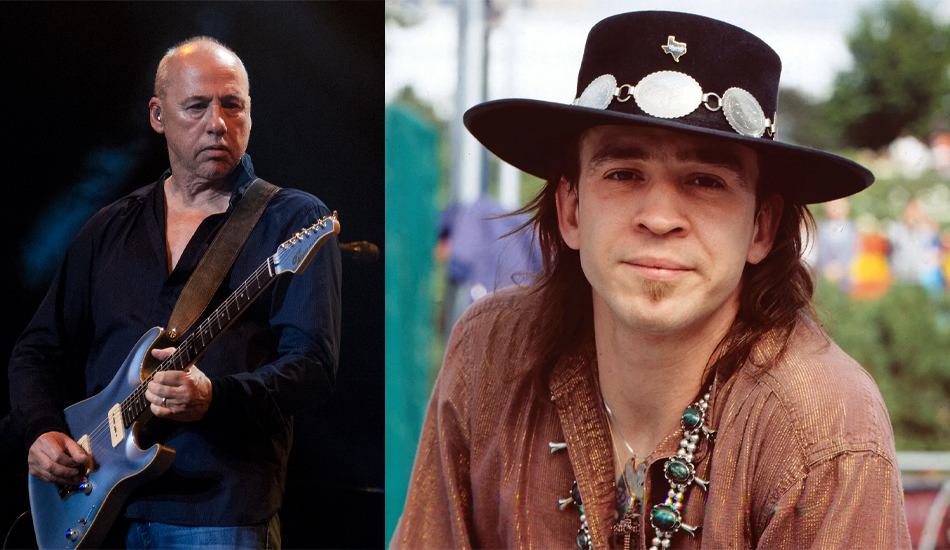
When Mark Knopfler praises another guitarist, guitar fans pay attention.
The Dire Straits legend has spent decades being celebrated for his own distinctive style, but one guitarist left a particularly strong impression on him: Stevie Ray Vaughan.
In a 1991 television documentary, A Tribute to Stevie Ray Vaughan — An Up Close Extra, Knopfler reflected on Vaughan’s development as a musician and explained why he believed the Texas blues guitarist had moved beyond his influences and created something completely his own.
“He’s one of the best I’ve ever heard. No question.”
It is difficult to imagine a stronger endorsement from one legendary guitarist to another.
What Mark Knopfler Heard in Stevie Ray Vaughan
By the time Knopfler was discussing Vaughan in 1991, Stevie Ray had already established himself as one of the most important blues guitarists of his generation.
His debut with Double Trouble, Texas Flood, had arrived in 1983 and immediately announced the arrival of a powerful new voice in electric blues. The album reached No. 38 on the Billboard 200 and eventually achieved double-platinum status in the United States.
But Knopfler was interested in something beyond Vaughan’s technical ability. He heard a musician developing.
Speaking in the documentary A Tribute to Stevie Ray Vaughan – An Up Close Extra, Knopfler first described Vaughan as “really, really tremendous.” He then pointed to a later stage in Vaughan’s career that impressed him even more.
Knopfler explained that the guitarist’s Hendrix and Buddy Guy influences were gradually developing into something more powerful and personal.
That distinction is important. Vaughan clearly understood the blues tradition, but he did not sound like someone simply copying the musicians who came before him.
From Hendrix and Buddy Guy to His Own Voice
Stevie Ray Vaughan’s playing was deeply connected to the blues. You could hear elements of Jimi Hendrix, Buddy Guy, Albert King, and other major influences in his phrasing, bends, vibrato, and tone. Yet Vaughan combined those influences in a way that became unmistakably his own.
That is exactly what Knopfler recognized. Rather than treating influence as something a guitarist should hide, Vaughan absorbed it and transformed it. His playing became a meeting point between traditional blues language and the intensity of modern rock guitar.
For Knopfler, that evolution was what separated Vaughan from countless talented players. He was not simply reproducing the past. He was turning the past into something new.
David Bowie Was One of the First Major Stars to Notice
Knopfler was not the only major musician to recognize Vaughan’s extraordinary talent. David Bowie saw Vaughan perform during the early 1980s and was immediately impressed. Bowie later recruited him to play on the landmark 1983 album Let’s Dance.
Vaughan’s guitar work on the record helped introduce him to an enormous international audience. It was a remarkable opportunity for a musician who was still developing his career.
Suddenly, the Texas blues guitarist was appearing on one of the biggest albums of the decade alongside one of popular music’s most influential artists.
Other Guitar Legends Saw the Same Quality
Vaughan’s ability to combine technique with emotion also impressed other guitar heroes. Eric Johnson praised him as a complete musician, while Steve Stevens recognized his ability to preserve the soul of the blues even when performing in a more modern rock environment.
That was one of Vaughan’s greatest strengths. He could play with enormous power without losing the emotional language of the blues.
His solos could sound aggressive, but they were never empty displays of speed. Every bend, vibrato, pause, and note had a sense of purpose.
Stevie Ray Vaughan Arrived at the Right Time — and Against the Trend
Vaughan’s rise was particularly remarkable because of the musical environment of the 1980s. The decade was increasingly dominated by hard rock, heavy metal, guitar virtuosos, and the emerging shred movement.
Technical ability was becoming a major part of guitar culture. Vaughan went in a different direction. He returned to the blues.
Instead of competing with guitarists through speed alone, he built his reputation around tone, feeling, rhythm, phrasing, and a deep connection with the traditions that inspired him.
That approach made him stand out. At a time when guitar heroes were often expected to demonstrate how fast they could play, Vaughan reminded listeners why the electric guitar could also be powerful simply because it could make people feel something.
The Road Was Not Always Easy
Vaughan’s success was not immediate everywhere. During an early tour with Huey Lewis and the News, Double Trouble reportedly struggled to connect with some audiences at first.
By the end of the tour, however, Vaughan had won people over. That ability to convert listeners through live performance became one of his defining qualities.
Seeing Stevie Ray Vaughan perform was not simply hearing a blues guitarist.
It was experiencing the physical power of the instrument, the interaction with the band, and the emotional intensity of a player who seemed completely immersed in the music.
Why Mark Knopfler’s Praise Matters
The relationship between Knopfler’s philosophy and Vaughan’s playing is especially interesting. Knopfler has always emphasized melody, phrasing, storytelling, and the importance of developing an individual voice.
Vaughan followed a different musical path, but the principle was similar. He absorbed his influences and then transformed them.
That is why Knopfler did not simply praise Vaughan’s technique. He praised the evolution of his musicianship. For a guitarist like Knopfler, that distinction matters.
Great players can inspire every musician, but the real challenge is finding your own voice and adding something personal to the music.
A Legacy That Became Even Bigger After His Death
Stevie Ray Vaughan’s career was tragically short. He died in a helicopter crash on August 27, 1990, at the age of 35. Yet his influence has continued to grow.
His recordings remain essential listening for blues and rock guitarists, while generations of players continue studying his tone, technique, phrasing, and approach to the blues.
For many musicians, Vaughan proves that artists can make traditional music sound fresh when they play it with conviction.
One Guitarist Recognizing Another
Among the many tributes Stevie Ray Vaughan received, Mark Knopfler’s assessment remains especially powerful. Knopfler was not impressed simply because Vaughan could play fast or produce an enormous guitar sound. He heard something deeper.
He heard a guitarist who had absorbed Hendrix, Buddy Guy, and the blues tradition, but who was gradually transforming those influences into a unique musical language.
That is why his words still resonate: “He was one of the best,” Knopfler said. “He was really, really tremendous.”
For fans of Mark Knopfler, Stevie Ray Vaughan, and great guitar playing, that single sentence says almost everything.
The greatest guitarists do not simply inherit a tradition. They add something to it — and leave the next generation with something new to discover.


Facebook Comments