
When people talk about the greatest British guitarists of all time, names such as Eric Clapton, Jimmy Page, Jeff Beck, David Gilmour, and Mark Knopfler usually dominate the conversation.
Yet long before those musicians became famous, there was another guitarist whose influence reached almost every corner of British rock music: Hank Marvin.
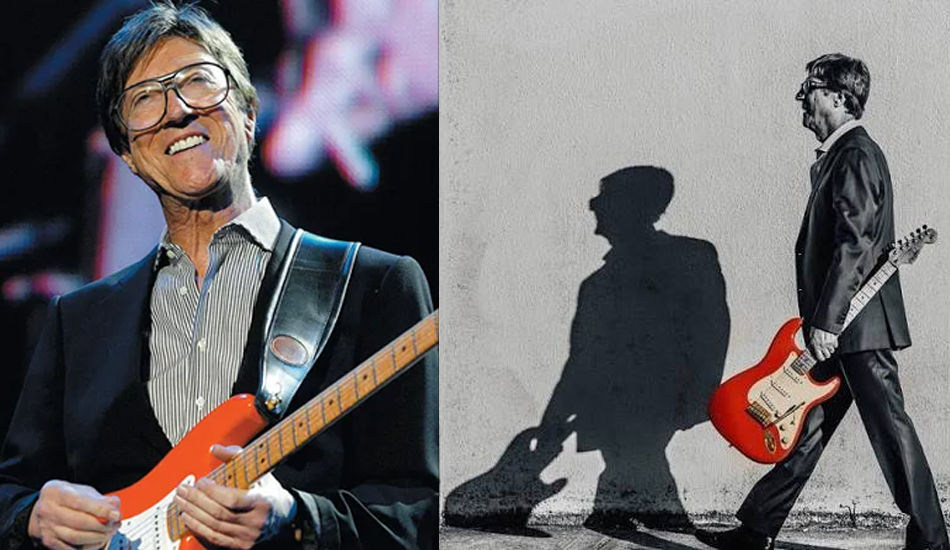
Although his name is less familiar to many younger listeners, Marvin helped shape the sound of electric guitar in Britain. His melodic playing, clean tone, expressive vibrato, and unmistakable Fiesta Red Fender Stratocaster inspired generations of musicians including Mark Knopfler himself.
England’s First Guitar Hero
Born Brian Robson Rankin in Newcastle upon Tyne on October 28, 1941, Marvin adopted the stage name Hank B. Marvin in 1958 to give himself a more American-sounding identity during the early days of rock and roll.
Before discovering the guitar, he experimented with piano, clarinet, and banjo. At the age of 16, he received his first guitar, a Höfner acoustic fitted with a pickup, before later moving to electric guitars.
His musical journey changed forever when he met guitarist Bruce Welch, and together they eventually joined the backing band of a young singer named Cliff Richard. That band would soon become The Shadows.
The Guitar That Changed British Rock
As Cliff Richard’s career began to take off, Marvin dreamed of owning a Fender Stratocaster. At the time, American-made guitars were almost impossible to find in Britain, but Cliff Richard offered to buy one for him.
Marvin chose a 1959 Fiesta Red Fender Stratocaster, believing that his guitar hero James Burton played one. He later discovered Burton actually used a Telecaster, but by then the Stratocaster had already become part of his identity.
That guitar would become one of the most recognizable instruments in rock history.
For decades, audiences around the world associated Hank Marvin with the red Stratocaster, just as later generations would associate Mark Knopfler with his own iconic red Strat.
The Secret Behind Hank Marvin’s Sound
While many guitarists relied on distortion and amplifier effects, Marvin focused on clean tone and expressive phrasing. One of the defining elements of his style was his use of the Stratocaster’s synchronized tremolo bridge.
Reflecting on it years later, Marvin explained:
“I took to the vibrato like a duck takes to water.”
Rather than using amplifier tremolo effects, he preferred controlling every note directly with his hands. The result was a lyrical, vocal-like guitar sound that became instantly recognizable.
“Apache” and the Birth of Instrumental Guitar Rock
In 1960, The Shadows released “Apache.” The instrumental became one of the biggest hits in British music history, spending six weeks at No. 1 in the UK and helping establish The Shadows as one of Britain’s first major guitar bands.
They followed it with classics including:
- “Wonderful Land”
- “F.B.I.”
- “Man of Mystery”
- “The Savage”
Before The Beatles transformed popular music, The Shadows were among Britain’s most successful bands, proving that instrumental guitar music could dominate the charts.
An Influence on Mark Knopfler
Although Mark Knopfler later developed a completely unique fingerstyle approach, he has never hidden his admiration for Hank Marvin.
Growing up in Britain during the late 1950s and early 1960s, Knopfler belonged to a generation of young guitarists who watched Marvin’s performances and dreamed of owning a Stratocaster.
Marvin demonstrated that the guitar could sing melodies rather than simply accompany songs.
That melodic approach would later become one of the defining characteristics of Mark Knopfler’s own playing.
It is no coincidence that both guitarists became closely associated with the Fender Stratocaster and built their reputations through tasteful phrasing rather than technical excess.
Respected by Rock’s Greatest Guitarists
Hank Marvin’s influence extends far beyond The Shadows. Many legendary guitarists have openly acknowledged their admiration for him, including:
- Mark Knopfler
- Brian May
- Ritchie Blackmore
- Tony Iommi
- Peter Green
- Peter Frampton
His contribution to British guitar playing became so widely recognized that the tribute album Twang! A Tribute to Hank Marvin and The Shadows brought together many of these musicians to celebrate his extraordinary career.
Even Pete Townshend contributed the album’s liner notes—a testament to the respect Marvin earned from his peers.
Life After The Shadows
As British rock evolved during the late 1960s, bands such as The Rolling Stones, The Who, Cream, The Kinks, and The Yardbirds changed the direction of popular music.
Although The Shadows gradually stepped away from the spotlight, Hank Marvin continued recording, touring, and releasing solo albums.
The band reunited several times over the following decades, with their final farewell tour taking place in 2004.
Looking back on that emotional final chapter, Marvin reflected:
“You could see the tears in people’s eyes… It was very, very emotional.”
A Legacy That Still Lives On
Hank Marvin may not always receive the same attention as some later guitar heroes, but his influence can still be heard in countless recordings.
Without his pioneering work, British guitar music and perhaps the careers of musicians like Mark Knopfler might have sounded very different.
His elegant phrasing, crystal-clear tone, expressive vibrato, and melodic approach transformed the electric guitar into a true lead instrument.
More than sixty years after “Apache”, Hank Marvin remains one of the architects of modern British guitar playing and a musician whose legacy continues to inspire generations of guitarists around the world.


Facebook Comments