
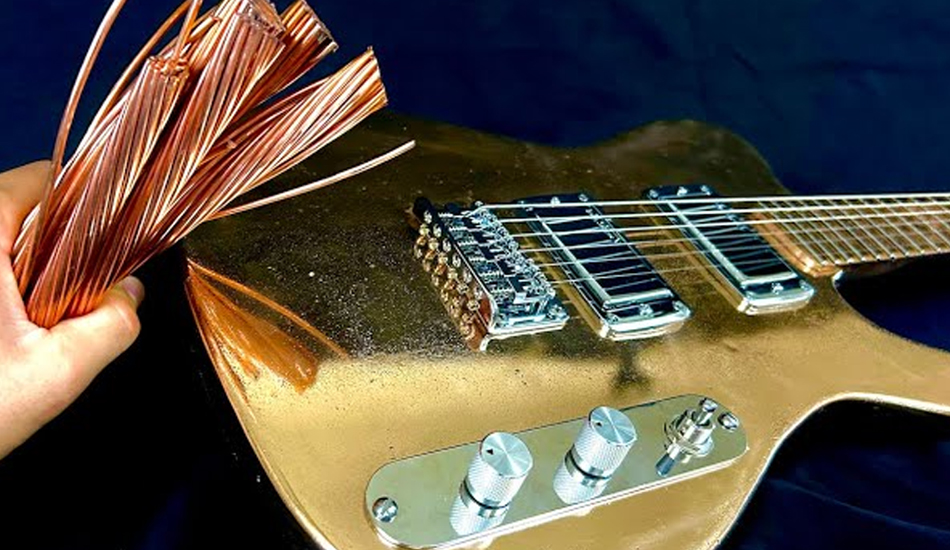
What if a guitar could be made almost entirely from metal?
For artist and YouTube creator Burls Art, that question became the starting point for one of his most ambitious and unusual guitar-building projects.
Using approximately 50 pounds of copper wire, several pounds of tin, traditional sand-casting techniques, and countless hours of manual work, Burls created the Steampunk Bronze Guitar — a fully functional electric guitar that weighs an astonishing 39.8 pounds.
The result looks like something from a futuristic workshop. It has a polished bronze body, visible casting imperfections, custom humbuckers, and a distinctive industrial appearance. But this is not simply a decorative sculpture. It is a real guitar — and, remarkably, it can actually be played.
The Idea Behind Burls Art’s Most Impractical Guitar
Burls Art has built a reputation for making guitars from materials that most guitar builders would never consider. His previous projects have included guitars made from 1,000 aluminium cans, newspapers, skateboards, and Himalayan salt, among other unconventional materials.
The Steampunk Bronze project pushed that philosophy even further. Instead of starting with a conventional wooden guitar and adding metal elements, Burls wanted to create the main structure of the instrument from cast metal.
He purchased approximately 50 pounds of copper wire, paying around $4 per pound. That meant roughly $200 worth of copper became the raw material for the experiment. The idea sounded simple. The execution was anything but.
Starting With the Guitar Neck
Burls began with the neck because it was easier to cast than the much larger body. He created a two-piece mould using Petrobond casting sand, a mixture designed for metal casting.
A wooden frame supported the mould while the original neck pattern was surrounded by the sand. The mould included a pouring channel and additional passages designed to allow air and steam to escape during the casting process.
Once the mould was prepared, Burls fired up his furnace and attempted his first copper pour. The result immediately showed him why casting a guitar from copper was going to be difficult.
The First Copper Neck Failed
The first neck casting suffered from poor metal flow and turbulence. More importantly, Burls discovered a serious problem with the material itself: copper is relatively soft.
After removing the first neck from the mould, he was able to bend it with pressure against his workshop table. A flexible guitar neck is obviously not the desired result.
Instead of abandoning the project, Burls changed the formula. He decided to turn the copper into bronze.
How Copper Became Bronze
For the second attempt, Burls combined copper with tin. He added approximately 2 pounds of tin to around 20 pounds of copper, creating an alloy that was significantly harder and stronger than the original copper.
The new bronze neck was much more promising. It still contained visible air pockets, small casting voids, and surface imperfections, but the basic structure was strong enough to continue.
Those imperfections would eventually become part of the guitar’s distinctive appearance.
Building the Bronze Guitar Body
The guitar body presented an even bigger challenge. Burls used a maple template to create a Telecaster-inspired shape. He initially considered using unusual cavities and cutouts to reduce the weight, but after doing the calculations, he realised that even an aggressively modified body would still weigh more than 20 pounds.
At that point, there was little reason to pretend this was going to be a lightweight instrument. So he embraced the idea. The body would be heavy. Very heavy.
Approximately 30 pounds of additional copper were prepared for the body, combined with bronze remaining from the neck casting.
The First Body Casting Had a Major Problem
The first body mould produced another set of challenges. The neck pocket did not completely fill, and Burls discovered that he had placed the control cavity on the wrong side of the guitar.
Because casting moulds effectively reverse the original design, the mistake was easy to make. Unfortunately, there was no simple way to correct it. The body had to be cut apart and melted down.
Fortunately, one advantage of working with bronze is that failed castings can be recycled. The metal could go back into the furnace and become part of another attempt.
Attempt Number Two
For the second body casting, Burls corrected the control cavity and changed the position of the pouring channel. He hoped the new arrangement would allow the molten bronze to travel more efficiently through the mould and completely fill the neck pocket.
The casting appeared to be progressing well. Then the mould suffered a dramatic blowout.
Molten bronze escaped from the side of the mould, creating another potentially disastrous moment. After the metal cooled, however, Burls discovered that the body had actually filled well enough to continue.
It was far from perfect. The back had a noticeable hump, and the casting contained numerous air pockets. But instead of starting over again, he decided to work with what he had.
Turning a Rough Casting Into a Guitar
This was where the project became extremely labour-intensive. Bronze is much harder to work with than aluminium or copper, and shaping the instrument required an enormous amount of sanding, cutting, and drilling. Even basic guitar-building tasks became major challenges.
Cutting the fret slots was particularly difficult. A small hacksaw that worked well on Burls’ previous aluminium guitar barely made an impression on the bronze.
He eventually used a cutting wheel attached to a Dremel and carefully created the fret slots by hand.
The fretboard radius was even more demanding. Burls spent three full days sanding the radius into the bronze fretboard, making it one of the longest individual tasks he had ever undertaken on one of his projects.
Fretting a Bronze Guitar Neck
Installing the frets created another unusual problem. Unlike wood, bronze does not compress easily. Instead of simply pressing the frets into the slots, Burls had to glue them into position and hold them while the adhesive cured.
He then had to level and recrown the frets to ensure the instrument could actually be played. The process required considerable patience. But eventually, the bronze neck was ready.
The Imperfections Became Part of the Design
One of the most interesting aspects of the Steampunk Bronze Guitar is that it is not perfectly smooth.
The casting contains visible voids, air pockets, and surface imperfections. Burls could have attempted to hide every flaw, but instead he accepted them as part of the instrument.
The imperfections contribute to the industrial, mechanical appearance of the guitar and reinforce its steampunk character. In many ways, the flaws became part of the artwork.
Polishing Nearly 40 Pounds of Bronze
Once the body and neck had been shaped, Burls began the final finishing process.
He wet-sanded the bronze up to 3000 grit before polishing it with a felt wheel. The result was a striking, mirror-like finish.
The polished surface made the casting imperfections even more visible, but Burls preferred the glossy appearance to a more subdued brushed finish. The final step was applying a protective coating designed specifically for polished metals.
This helped prevent the bronze from continuing to oxidise while preserving its reflective appearance. Then came the hardware and electronics. The Steampunk Bronze Guitar was finally complete.
The Hardware Behind the Guitar
Despite its unconventional construction, the guitar uses serious professional hardware. According to the official Burls Art specification, the Steampunk Bronze features:
- 25.5-inch scale length
- Custom Lace Horsepower humbuckers
- Hipshot locking tuners
- Bronze body and neck
- Fully functional electric guitar electronics
The result combines conventional electric-guitar components with an almost entirely unconventional construction. It looks like a piece of industrial art, but it behaves like a real electric guitar. There was just one enormous problem.
The Guitar Weighs Nearly 40 Pounds
The finished Steampunk Bronze Guitar weighs 39.8 pounds. That is roughly the weight of a small child, concentrated into a guitar-sized instrument.
Burls quickly discovered that normal guitar stands were not necessarily designed for something this heavy. At one point, an adjustable guitar stand collapsed under the instrument.
That experience also influenced another important decision. There are no strap buttons.
Burls did not want someone attempting to play the guitar standing up only to have a strap fail and send nearly 40 pounds of bronze crashing to the floor — or onto someone’s foot.
The guitar is better suited to a sturdy display stand or a properly mounted wall hanger.
Can You Actually Play a 40-Pound Guitar?
Surprisingly, the answer is yes. The Steampunk Bronze Guitar functions like a normal electric guitar, and Burls demonstrates the finished instrument at the end of the build video. The problem is not the electronics. It is the weight.
When playing while seated, Burls says the guitar begins to put significant pressure on his leg after only a few minutes. The experience is particularly strange because the instrument does not look nearly as heavy as it actually is.
Visually, it remains relatively compact. Physically, however, it is an entirely different story. Burls ultimately concluded that the guitar is probably the first and last instrument of its kind.
The Ultimate “Heavy Metal” Guitar
The project has attracted attention partly because of its wonderfully literal interpretation of the phrase “heavy metal.”
Guitars have been described as heavy metal instruments for decades. This one actually is heavy metal.
It is made from bronze and weighs almost 40 pounds. The combination of traditional guitar design, industrial metal casting, and steampunk aesthetics makes it unlike almost anything else in the guitar world.
A Viral Guitar-Building Experiment
Burls Art published the complete build video on June 7, 2024. The approximately 21-minute video documents the entire process, including the failed neck casting, the conversion from copper to bronze, the body moulds, the casting blowout, the machining, sanding, polishing, and final assembly.
The video eventually became a viral success. By August 2026, it had accumulated more than 3.4 million views and over 3,450 comments.
The popularity of the project shows why Burls Art has developed such a large following among guitar enthusiasts.
His projects are not simply about building unusual instruments. They are experiments that challenge the traditional definition of what a guitar can be.
A $4,500 One-of-a-Kind Guitar
The Steampunk Bronze Guitar was sold by Burls Art for $4,500. (source: burlsart.com)
The official description makes clear that this is not intended to compete with a conventional electric guitar. Especially, in terms of comfort or practicality. It is a collector’s piece.
The guitar is unique, handmade, and extremely difficult to reproduce. The visible casting imperfections are part of its character. While on the other side, the bronze construction makes it an extraordinary example of experimental guitar craftsmanship.
A Guitar Built Without Practicality in Mind
There is something refreshing about the Steampunk Bronze Guitar. Most guitar design is about solving problems. How can an instrument become lighter and more comfortable? How can it produce better tone and can it survive years of touring?
Burls Art approached the project from the opposite direction. He asked a much simpler question: What if we made a guitar out of bronze anyway?
The result does not make practical sense. And that is precisely what makes it fascinating.
Why the Steampunk Bronze Guitar Matters
The Steampunk Bronze Guitar is more than an unusual musical instrument. It represents experimentation, craftsmanship, and the willingness to follow an idea simply because it sounds impossible.
Burls Art took 50 pounds of copper wire, transformed part of it into bronze with tin, cast a guitar neck and body, reshaped the metal by hand, installed professional guitar hardware, and ultimately created an instrument that actually works.
It may be far too heavy for a normal gig. It may be completely impractical for everyday playing. But it proves something important about guitar building: there are still new ways to challenge the instrument’s traditional boundaries.
And sometimes, the most memorable guitars are not the ones that make the most practical sense. They are the ones that make people stop and ask: “How on earth did someone build that?”


Facebook Comments