
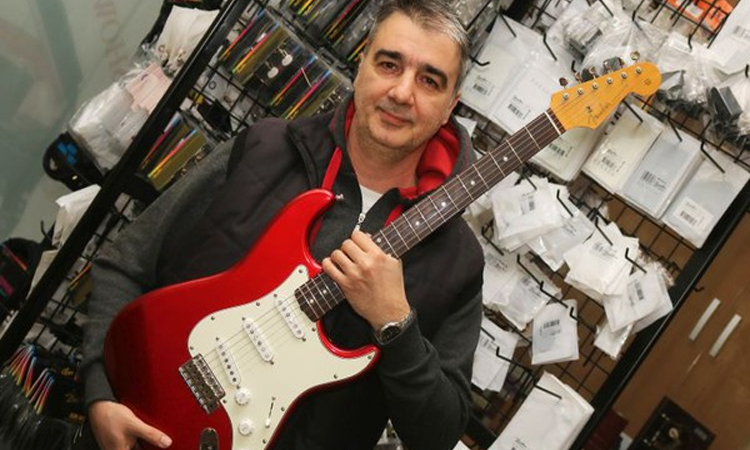
Srdjan Jankovich, a guitar master from Salajka, Serbia, has been playing the guitar since he was 14. Although, he started with the bass guitar because the six-string guitar was a point of contention among his peers. His first guitar was a Jolana from Czechoslovakia. He says looked and worked oddly, but it was the most beautiful and the best for him at that time.
Srdjan began producing chords in the local community of Paor, where he learned patterns from the older musicians. Despite the worn-out records and cassettes, he repeated parts relentlessly to learn and download the song.
At the age of 16, he saw the studio for the first time at Maret’s in Veternik. After the army, he went to Pera Bahun’s guitar lessons for several years. Then he heard Stevie Ray Vaughn and his life changed. It became the blues. He played in several bands and at the end of the 1990s, he founded the band The Blues Hammer.
Srdjan in addition to playing the guitar has also become a master of the same. According to the musician, he is one of the best in the city. With his friend Veljko, he went a step further, so for a while, they made electric guitars. However, the story stopped like any good thing in Serbia. So, he is currently working on replacing frets and electronics, making combs, and everything else related to guitar maintenance and repair.
“I was not satisfied with how people changed my thresholds. There were muffled tones, and strings hanging out, it just wasn’t well done, so I decided to try it myself. I couldn’t start right away because the work is such that it requires a specific tool. I ordered tools from America and something from Germany, and for 15 years now I’ve been doing more serious work on guitars.”
“Previously, there was a problem with masters in Novi Sad because there weren’t any, so most musicians sold their guitars when the frets wore out. Now there are at least four craftsmen in the city who can do any type of work with quality. Guitars need regular service just like cars, but our people don’t have that culture. The inspection must be done twice during the year when the seasons are changing, to see how the bar in the neck works, to exchange the wires a little, take it apart, inspect it and that’s it. I have regular customers, and most of them are professionals who regularly play and really “wear out” the guitar”, he said.
For Srdjan, the fact that people play and practice less, and there are fewer original bands is devastating. Musicians have turned to stalling and fast hunting, and musical creativity is declining.
He knows this from the young people who come to him often, overthinking and making excuses. If he had the same opportunities when he started playing, he believes his happiness would have lasted longer. Though each era has its own benefits, nowadays, learning to play the guitar can be easily accessed online.
“In two years, we made five guitars. They were quite good, but we stopped because it is unprofitable in Serbia. In order to make a guitar in Serbia that works well, the retail price must be 800 to 850 euros. Realistically, no one here will pay that much money, although they will rather buy an ordinary Fender Stratocaster in the store for 1,500 to 2,000 euros, which at the same time works worse than our guitar.”


“The attitude is like that because our customer immediately thinks about how he will get money and whether he will be able to sell the guitar, so he has to write Fender.” The experience with musicians outside of Serbia is completely different. He just cares if the guitar works well.”
“You don’t have to convince a real guitarist of anything. So the Greek musician Sakis Dovolis bought our guitar. He tried it and immediately ordered it. By the way, the guy is already seriously playing in Europe, and he signed a contract with a New York publishing house. Everything was handmade as Fender did in the 1950s. We procured wood from Russia, so the guitars went under the name Yaroslavsky, after that Russian,” explained Srdjan.
As we discovered, they constructed Stratocasters and Telecasters using alder for the body, maple for the neck, and rosewood for the fingerboard. They even fashioned one Telecaster entirely from mahogany and used rosewood for the fingerboard. Not only did they sell three guitars in Novi Sad, but one guitar also ended up on an overseas ship.
The moment when he started making guitars, Srdjan had about 30 years of experience as a musician. So it was not difficult for him because they knew what they wanted to get and did not experiment much. They worked to Fender’s blueprint, used even better wood, and the quality of hardware, keel, and electronics were the same as Fender’s. Such a circuit cannot fail.
“We received a roughly cut body and neck, and here we did a little manual woodworking, painting, varnishing, placing frets, fitting the neck to the body, assembling the electronics, and finally the entire guitar. We worked slowly, but from the moment the customer orders the guitar and receives the case, it takes up to four months.”
“The warranty on the wood was five years, but of course, it doesn’t apply if the guitar falls or if you keep it in the car at 40 degrees Celsius. Our customers did not complain about the quality. We took the suitcases from “SMS Music”, with whom I still work very well. We didn’t earn anything, we broke even, but we had a good time and learned a lot of things, which is a serious profit.”
“In rock music, Fender and Gibson are the most represented. Ibanez may be in third place, then Grech, and Yamaha. I rarely buy a new guitar because old wood works better. Scientists say that it takes 30 years for the resin and moisture to come out of the wood and then it will play properly. If we are talking about the same class of guitar, the new one can never play better than the old one” – concluded the guitar master.
HENDRIX IS OUT OF COMPETITION
Jimi Hendrix, Stevie Ray Vaughn, Albert King, BB King, Billy Gibson, Frank Marino… are the best guitarists for Srdjan. He says about Hendrix that he is out of competition, that he was ahead of his time, that the music just came out of him, and that it wasn’t about practicing. Although, he tells kids and older guitarists to practice, practice without compromise. His band The Blues Hammer recently celebrated two decades of existence.
“I stayed true to blues rock, and so it is in my band. The most important thing for me is that the song is good. That has a melody and rhythm that enters the ears, and it seems powerful and melodious. As a band, we have one LP behind us, we will probably do another one because the songs are ready. We are based only on festivals. We were recently in Skopje, Macedonia, and now we are going to Sofia, Bulgaria.”
“It’s the sweetest thing for me when people don’t feel what our thing is during the concert, since we also play the songs of top blues artists. We’re not a classic blues band, we’re a little harder. Our gigs are energetic with three backing vocals,” said the leader of Blues Hammer.


Facebook Comments