
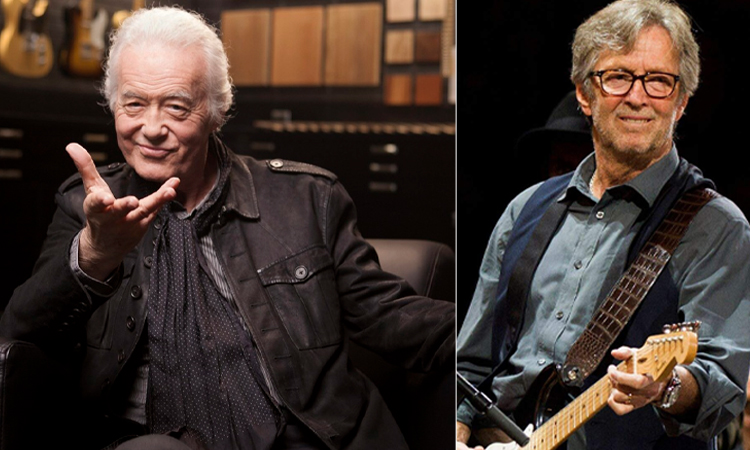
Some moments in music history show that even the greatest musicians can surprise the people around them.
During the 1960s, Eric Clapton was already becoming one of the most respected guitar players in the world. His unique tone, powerful playing style, and creative approach to the instrument made him a revolutionary figure in blues and rock music.
However, there was one recording session where his incredible guitar sound became so powerful that an engineer described him as “impossible to record.”
The story was later shared by Jimmy Page, who witnessed the unusual studio moment while working as a producer.
Jimmy Page and Eric Clapton at Pye Studios in 1965
The story takes place in 1965 when Jimmy Page was working as a producer for John Mayall’s single “I’m Your Witchdoctor / Telephone Blues.”
The recording session took place at Pye Studios in London and featured an impressive lineup of musicians:
- John Mayall – vocals and keyboards
- Eric Clapton – guitar
- John McVie – bass guitar
- Hughie Flint – drums
At that time, Clapton was already gaining worldwide attention for his work with The Yardbirds and later became one of the key figures in British blues.
Jimmy Page, who would later become famous as the guitarist of Led Zeppelin, was involved behind the scenes as a producer and helped shape the sound of the recordings.
Eric Clapton’s Experimental Guitar Sound
During the recording of “I’m Your Witchdoctor,” Clapton wanted to create something special.
He decided to add a feedback guitar effect as an overdub. Jimmy Page stayed close during the process while Clapton experimented with his guitar sound. After Clapton started recording the overdub, Page moved back to the control room to monitor the session.
However, something unexpected happened.
Around two-thirds of the way through the recording, the engineer suddenly pulled down the faders and stopped the process. His reaction was surprising:
“This guitarist is impossible to record.”
According to Page, Clapton’s powerful guitar signal was pushing the recording levels too far, creating a technical challenge inside the studio.
Jimmy Page Defends Eric Clapton’s Creative Vision
Jimmy Page did not agree with stopping the recording. Instead, he immediately defended Clapton and his approach. Page responded:
“I suggested that he got on with his job and leave that decision to me.”
For Page, the priority was not simply following technical rules. It was about capturing the creativity and emotion of a musician pushing the boundaries of sound.
This moment perfectly represents the experimental attitude of 1960s recording sessions, when musicians and producers were constantly searching for new ways to create unique sounds.
The Brilliant Guitar Work on “Telephone Blues”
Although the “I’m Your Witchdoctor” recording session had its challenges, Clapton’s performance on the B-side track “Telephone Blues” received great praise from Jimmy Page. Page later described Clapton’s guitar solo as:
“Just superb.”
The recording became another example of why Clapton was considered one of the most influential blues guitarists of his generation. His ability to combine emotion, technique, and tone helped define the sound of British blues during the 1960s.
Jimmy Page’s Early Career as a Producer
The session was also an important part of Jimmy Page’s early career. Before becoming the legendary guitarist of Led Zeppelin, Page was already an experienced studio musician and producer. He worked with many artists and helped create recordings that shaped the sound of British rock and blues.
Page also produced John Mayall’s track “Sitting On Top of the World,” showing his interest in bringing blues music to a wider audience.
A Historic Meeting of Two Guitar Legends
The story of Eric Clapton being called “impossible to record” is more than just a funny studio anecdote. It represents a period when musicians were experimenting, taking risks, and changing the future of popular music.
Eric Clapton’s powerful guitar style, combined with Jimmy Page’s production skills, created a memorable moment from one of the most exciting eras in rock history.
Decades later, both musicians remain icons. Their influence continues to inspire guitar players around the world.


Facebook Comments