
The story of Mark Knopfler’s music does not begin with Dire Straits. Before the band became one of the biggest names in rock, Knopfler spent years searching for his voice as a musician and songwriter.
He worked as a journalist, studied at university, played in different bands, and gradually built a collection of songs that would eventually become too strong to ignore.
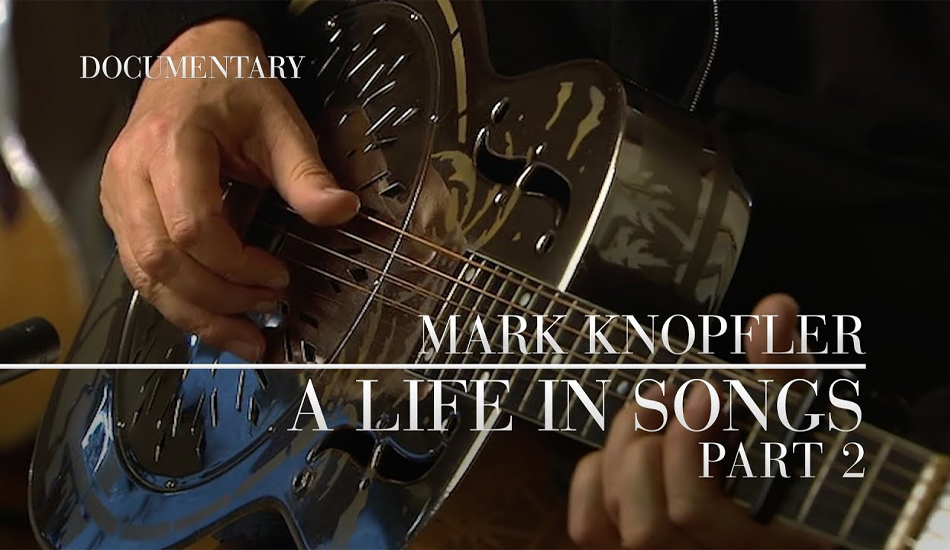
The second part of the official documentary “Mark Knopfler – A Life in Songs” explores that important period. Published on September 8, 2017, the 13-minute-and-26-second film follows Knopfler from his early working life through the formation of Dire Straits and the development of some of his most celebrated songs.
From Journalism to the Birth of Dire Straits
After finishing school at 18, Knopfler moved south to Essex to train as a journalist.
A year later, he returned north after accepting a position as a junior reporter at the Yorkshire Evening Post in Leeds. He would remain in the city for around six years while continuing to develop his music.
Looking back, Knopfler describes journalism as an important education. Working in a newsroom forced him to organize information, make sense of complicated situations, and pay attention to the world around him. Those skills would later become valuable in his songwriting.
During his time in Leeds, he continued playing music and writing songs. He also studied English at Leeds University before eventually taking a teaching position in Essex.
But by then, the songs had become increasingly difficult to ignore. Knopfler describes them almost as a force pushing against a door. The more songs he wrote, the stronger the pressure became to find a way to record them.
The Formation of Dire Straits
Against the background of the emerging punk scene, Knopfler finally decided that he had to create a situation where his songs could be recorded.
In 1977, he formed the group that would become Dire Straits with his brother David Knopfler, bassist John Illsley, and drummer Pick Withers.
The lineup gave Knopfler the opportunity to move beyond simply writing songs at home or performing in small groups. He finally had a band capable of turning those compositions into recordings.
The group’s early demo eventually reached Charlie Gillett, the influential London radio DJ. Gillett played the tape on his radio show, helping bring Dire Straits to the attention of the music industry.
The exposure led to a record deal with Vertigo Records. After years of writing and waiting, Knopfler finally had an outlet for his songs.
“Sultans of Swing” – The Song That Changed Everything
Dire Straits made their television debut in May 1978, performing the song that would become their calling card: “Sultans of Swing.”
But the story behind the song had started much earlier. Knopfler remembers walking into a small pub in Deptford one rainy evening and discovering a little Dixieland jazz band playing to almost nobody.
There was hardly any applause. At the end of the performance, the band’s leader announced that they were the Sultans of Swing.
The contrast amused Knopfler. The name sounded grand and glamorous, while the surroundings were anything but. That simple moment eventually became one of the most important songs in Dire Straits history.
Knopfler also explains how his background as a journalist influenced his songwriting. As a reporter, he learned to notice details, collect observations, and store them away.
Some of those observations might eventually find their way into a song.
Why the Band Changed His Songs
One of the most revealing moments in the documentary concerns the relationship between songwriting and performance.
Knopfler explains that a song may begin as a very personal idea, but once the band starts playing it, unexpected things happen.
Musicians add parts, rhythms change, harmonies develop, and spontaneous performances become part of the final arrangement. He believes that some of those improvised moments eventually become part of the song’s permanent architecture.
“Sultans of Swing” is an excellent example. The famous extended guitar passage at the end became part of what audiences expected to hear.
For Knopfler, those details eventually stop feeling like optional additions and become part of the identity of the song itself.
The Success That Came With a Price
The success of the first Dire Straits album was enormous. “Sultans of Swing” became a worldwide hit, while the band’s debut album reached audiences far beyond Britain.
Suddenly, the small group that had been struggling to get its songs recorded was performing in larger venues and travelling internationally.
But Knopfler quickly discovered that success had another side. Touring takes time. When a musician spends months on the road, there is less time available for writing, practicing, experimenting, and simply thinking.
Knopfler explains that this became a problem after the band’s first album. He was playing more concerts, but he was not developing as a musician or songwriter at the same pace.
This realization would influence the direction of the band’s next records.
“Making Movies” and the Move to New York
By the time Dire Straits began work on Making Movies in 1980, Knopfler had moved from London to New York. The new environment influenced his songwriting.
One of the clearest examples is “Romeo and Juliet.” Knopfler describes the song as being connected to a more theatrical and cinematic way of thinking. He was imagining something closer to the world of West Side Story than the earlier atmosphere of songs such as “Wild West End.”
The song also grew from an unusual guitar idea. Knopfler played his National steel guitar in an alternative tuning while searching for the musical doorway into the composition. He describes the opening as almost a fortunate accident.
That distinctive guitar pattern became one of the most recognizable introductions in his entire catalogue.
“Romeo and Juliet” – When a Song Becomes Its Own Character
Knopfler has a fascinating way of describing his songs. He does not always think of them simply as finished compositions. Instead, he sees them almost as living things.
Once a song has been written and recorded, it leaves the songwriter and begins its own life. That idea explains why Knopfler continues to enjoy performing songs that are decades old.
He believes that every song needs something real to remain alive. Playing it exactly as a piece of history is not enough. The musician also has to find something in it for himself.
“Tunnel of Love” and Memories of Newcastle
Another major song discussed in the documentary is “Tunnel of Love.” This time, Knopfler looks back toward his childhood in the Northeast of England.
He remembers visiting Spanish City in Whitley Bay and travelling there by train from South Gosforth. The fairgrounds and amusement rides left a strong impression on him as a child.
Those memories later became part of the emotional world of “Tunnel of Love.” It is a perfect example of something that happens repeatedly in Knopfler’s writing. A memory may remain hidden for decades before suddenly finding a place inside a song.
The Past Never Really Leaves the Songwriter
By this stage of the documentary, a clear pattern has emerged. Knopfler may travel to New York, tour the world, or become internationally famous, but his earliest experiences continue to influence his writing.
The Northeast of England remains somewhere inside the songs. So do his years as a journalist, his early folk performances, his fascination with blues and rock guitar, and his experiences with other musicians.
For Knopfler, creativity appears to be a long process of collecting experiences and allowing them to return when the right song arrives.
Watch “Mark Knopfler – A Life in Songs” Part Two
The second part of “A Life in Songs” provides a fascinating look at the period when Mark Knopfler moved from journalism and small musical projects toward international success with Dire Straits.
It explains how his years in Leeds helped shape his writing, how Charlie Gillett helped bring the band’s demos to the public, and how songs such as “Sultans of Swing,” “Romeo and Juliet,” and “Tunnel of Love” grew from very different experiences.
For Dire Straits fans, guitar players, and anyone interested in songwriting, the documentary offers something special: Mark Knopfler explaining not only what he wrote, but why the songs became what they became. Watch the official part two below and continue the story.


Facebook Comments